






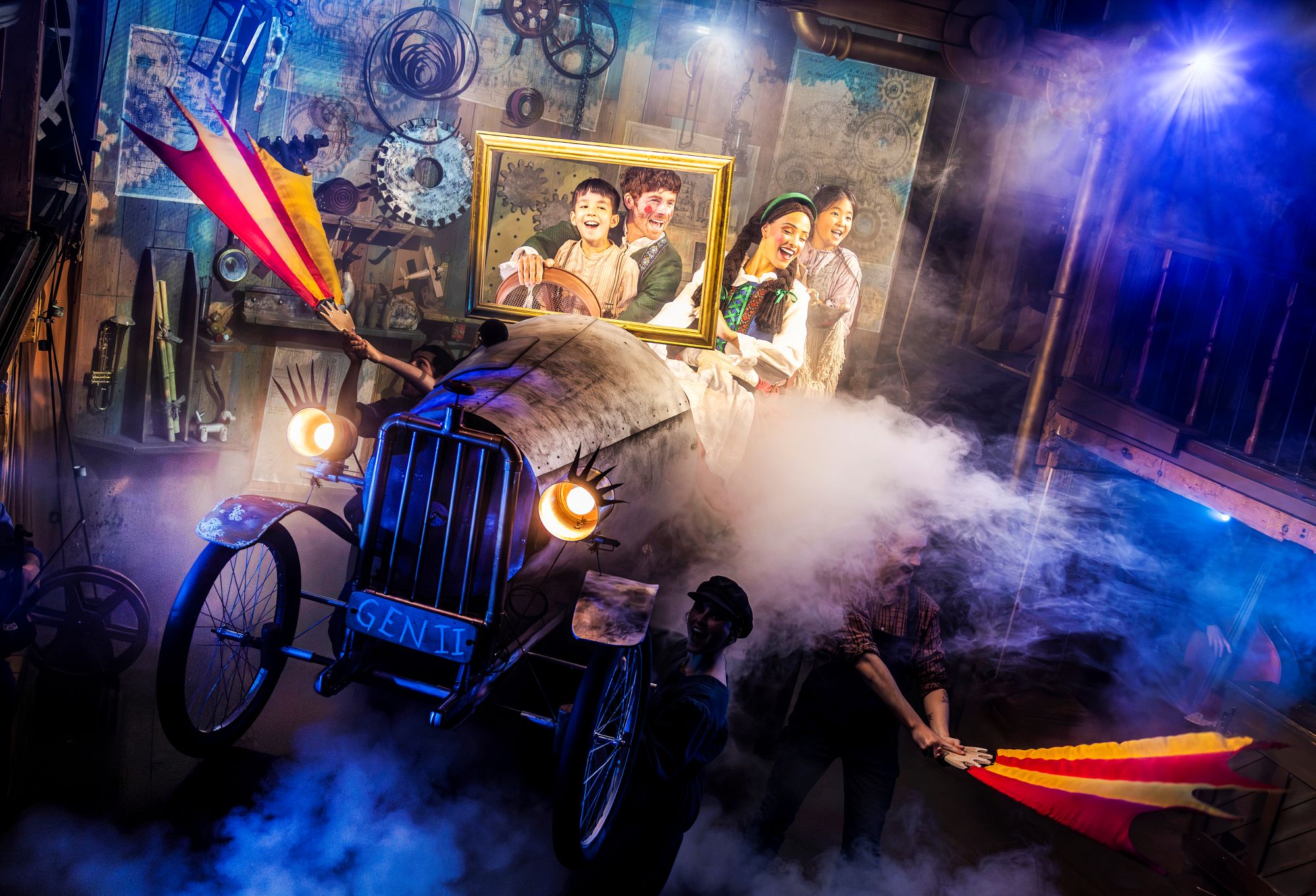
White Light (WL) is proud to have supported the Watermill Theatre’s ambitious new production of Chitty Chitty Bang Bang, where lighting designer Jai Morjaria has delivered a bold and inventive design that transforms a compact venue into a world of spectacle.
Tasked with reimagining a much-loved musical within one of the UK’s most intimate theatre spaces, Morjaria approached the project with a clear brief to achieve the seemingly impossible. A single small stage needed to represent multiple locations while also accommodating a flying car, meaning lighting became central to how the story was told and experienced.
“We had to find a way to make a show that takes place in so many different locations exist within one small space, whilst still delivering the magic,” explains Jai.
This production differs significantly from traditional large-scale versions of Chitty Chitty Bang Bang. With a cast of actor-musicians and limited space, the design relies on creativity rather than scale. Lighting plays a pivotal role in supporting illusion and enhancing the integration of puppetry, automation and set.
“Lighting played a huge role in helping the illusions read, especially with an audience sitting just feet away,” he adds.
Designing for the Watermill’s immersive environment brought a unique set of challenges. Audience members sit in close proximity to the action, sometimes just a few feet from the performers and technical rig so the lighting needed to deliver clarity, consistency and impact across every seat in the auditorium.
“Someone in the front row could be three feet from the action, while someone at the back deserves just as much spectacle. We had to deliver seamless illusions for every viewpoint as well as enough space for those close to the car,” says Jai.
The technical solution combined flexibility, reliability and performance. Inside the theatre, a rig built around Martin MAC Aura and Ayrton Diablo fixtures provided a rich colour palette, precision control and low-maintenance performance, essential in a venue where access is limited and fixtures must remain in place for extended periods.
The production extended beyond the main stage, with additional performance areas including a circus tent and outdoor environments. This required a cohesive lighting approach across the entire site, ensuring the audience experience remained consistent from arrival through to the performance itself. Flicker-free lighting was prioritised to support audience interaction and social content capture, enhancing engagement beyond the show.
Technology played a significant role in unlocking creative possibilities. The use of wireless lighting, LED sources and atmospheric effects enabled a range of dynamic moments, from subtle storytelling cues to playful details such as illuminated elements within the car itself. These innovations allowed the team to deliver effects that would have been difficult to achieve in a venue of this scale, even a few years ago.
While the flying car is a defining moment of the production, lighting underpins many of the show’s most memorable scenes. From transforming the stage into multiple locations to supporting high-energy musical numbers, the design brings pace, colour and clarity to the storytelling. One standout moment for Jai is the vibrant “Bombie Samba” sequence, where bold colour choices and dynamic effects create an energetic visual shift.
“One of my favourite moments was lighting a number called ‘Bombi Samba’, where the Baroness performs a big dance number. It was an exciting, flamboyant and jazzy sequence that gave me the opportunity to work with bold, vibrant colours,” he notes.
Collaboration was central throughout the process. Morjaria worked closely with director Paul Hart, set designer Katie Lias and the wider creative team to ensure lighting integrated seamlessly with every aspect of the production. He also worked with Associate Lighting Designer Sam Osborne, Production Electrician Ryan Tate, Production manager Neil Starke and the WL team to deliver a tailored solution that maximised both creative ambition and technical constraints.
“WL’s Adam Walker-Cheetham was incredible. The level of support and the rig we achieved would not have been possible otherwise,” comments Jai.
WL’s Key Account Manager Adam Walker-Cheetham comments: “Supporting Jai, Sam and the lighting team at The Watermill to realise their creative vision while overcoming technical challenges has been incredibly rewarding. The results look amazing. It was a pleasure being able to guide them with their fixtures choices.”
Ultimately, the success of Chitty Chitty Bang Bang at the Watermill lies in its ability to deliver a large-scale theatrical experience within an intimate setting. For Morjaria, the lasting impact of the production is not the spectacle alone, but the emotional connection it creates with audiences. “Giving people that sense of joy and escape is what really matters,” he concludes.
Lighting Designer: Jai Morjaria.
Associate Lighting Designer and Programmer: Sam Osborne.
Production Electrician: Ryan Tate.
Technical & Production Manager (Watermill Theatre): Neil Starke.
Deputy Technical & Production Manager (Watermill Theatre): Charlie Hodsdon.
Theatre Technician (Watermill Theatre): Ruth Corris.
Associate Production Manager: Jordan Harris.
Photography: Pamela Raith.
Share this story



October 2026 issue
2026 A1 Buyers Guide