








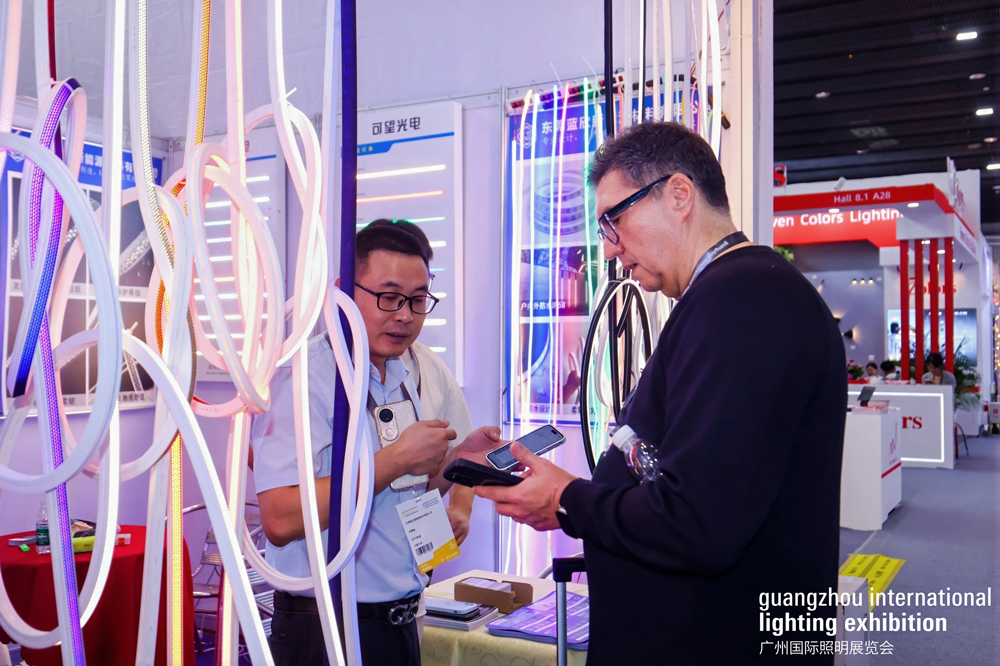
Guangzhou International Lighting Exhibition (GILE), one of the world’s largest trade fairs for the lighting industry, returns for its 2026 edition from 9th – 12th June at Areas A and B of the China Import and Export Fair Complex, running concurrently with Guangzhou Electrical Building Technology (GEBT). Across 21 halls and 210,000 sqm, the two shows are expected to draw more than 2,500 exhibitors, bringing together manufacturers, government bodies and industry associations covering technological development, supply chain integration, and the transition towards lower-carbon manufacturing and design. Among the headline features of the 2026 edition is a new regional pavilion for Guzhen, Guangdong Province, the lighting manufacturing town known as the “Lighting Capital of China”.
The 2026 edition is centred on the concept of “Light-Enhanced Living”, exploring five application pillars, Biological, Emotional, Digital, Ecological, and Immersive, as a framework for understanding light’s role across daily life, public space, commerce, agriculture and culture. Across the show floor, this range is presented through a variety of regional industry pavilions, application-led exhibition zones, curated installations and technology showcases.
China Lighting Capital Hall
New for 2026, the China Lighting Capital Hall (Area A, Hall 8.1) is dedicated to the town of Guzhen in Zhongshan city, Guangdong Province. With sales accounting for more than 70 percent of China’s domestic lighting market and half of the global market,[1] Guzhen has developed into one of the world’s most significant centres for the industry.
Organised under the advisement of the Bureau of Commerce of Zhongshan City and the Guzhen Town People’s Government and co-organised by Guzhen Town Federation of Industry and Commerce (Chamber of Commerce), Zhongshan City, Zhongshan Lighting Electric Appliance Industry Association, Yang Lighting, Zhongshan Lighting Factory Cross-border Spot Alliance and Zhongshan Sima Cross-border Network Technology Co Ltd, this pavilion brings the expertise of the “Lighting Capital of China” to GILE. It connects project buyers, designers, cross-border e-commerce platforms and trade distributors with the town’s manufacturers and traders across a wide range of lighting categories, while giving local lighting enterprises a point of entry into international markets.
Household and Commercial lighting
For the home, lighting touches nearly every aspect of how a space is designed and lived in. Area B, covering household and commercial lighting (Halls 9.1 – 11.1, 9.2 – 11.2 and 9.3 – 10.3), approaches residential lighting across four areas: technology, health, aesthetics and sustainability. Smart controls and full-spectrum lighting are increasingly designed to align with daily routines, while recycled and low-carbon materials support more sustainable production. Aesthetically, minimalist and concealed lighting continues to define modern interiors, while natural materials and standalone fixtures serve as design focal points.
In commercial spaces, lighting has evolved from a basic operating expense into a practical business tool. AI-enabled fixtures can respond to their environment in real time, adjusting office lighting based on natural light levels and occupancy or directing shoppers towards specific retail displays. Across both home and commercial applications, combining automated controls with circadian lighting enables users to fine-tune the mood and character of a space.
The area also hosts Design Aesthetics Exhibition III (Hall 10.1), presented in partnership with Italian magazine Luce e Design. Continuing an annual series that began with “East Meets West” (2024) and “A Tale of Two Circles” (2025), the 2026 edition, “Light, Space and the Future”, draws on art and nature to lead visitors through contrasting spatial experiences, tracing how light shifts in character as it moves between open, communal environments and quieter, more enclosed settings.
Urban & Cultural Tourism lighting
Urban and cultural tourism lighting occupies Area A (Halls 1.1 – 5.1), sitting at the intersection of technology, culture and sustainability. Projection mapping, intelligent dimming and scene programming are changing how historic buildings and regional landmarks are experienced after dark, extending their appeal late into the evening. Coordinated lighting schemes create visual continuity from major landmarks to residential streets, while AR technology allows visitors to access cultural and historical context as they move through these night-time environments.
Within Area A (Hall 1.1) the The Cultural Tourism Visual Show brings together leading companies across landscape lighting, interactive projection, stage effects and digital multimedia. It also features Visual Magic Box 2026, a curatorial project by Aladdin that unites directors, lighting designers, artists and engineering firms to create immersive experience spaces for the night-time tourism economy.
Growth categories in 2026: AI lighting, health lighting, power and components
Several product categories are emerging as major growth drivers for the industry, represented across both Area A (Halls 2.2 – 5.2) and Area B (Halls 9.2 – 10.2, 10.3).
AI lighting systems are increasingly designed to do illuminate. By sensing environmental conditions, responding to occupant behaviour and connecting with building IoT infrastructure, they create adaptive, personalised environments. The data they generate also supports “Light as a Service” as a viable commercial model, where lighting is no longer bought outright, but delivered as an ongoing, managed service.
AI health lighting applies the same capabilities to human health and wellbeing. Fixtures use AI data analysis to adjust light conditions in response to occupant needs, supporting health and comfort while also contributing to the low-carbon performance of the buildings they sit within.
Meanwhile, Power supplies and chip packaging (Area A: Halls 2.2 – 4.2) highlights the components that enable these advancements. Co-packaged light engine modules, combining drivers and chips into a single unit, are increasingly becoming the foundation on which AI-enabled lighting products are built.
Bio-optics and Smart Agricultural Lighting
Also making its debut at GILE 2026, this zone covers bio-lighting across six application settings: home gardens, office greenery, controlled-environment cultivation, smart seedling propagation, industrial collaboration and research commercialisation. Two concurrent events run alongside: the 2nd Guangya Smart Agricultural Lighting Award, recognising innovative and commercially viable agricultural lighting technologies, and the Guangya Digital Intelligence Forum in Agriculture, connecting early-career researchers, industry partners and practitioners to share findings and support pathways from the laboratory to the field.
Commenting on the vision behind this year’s edition, Ms Lucia Wong, General Manager of Messe Frankfurt (HK) Ltd stated: “GILE gives the industry a platform to act on market opportunities and push forward with the innovation and transformation the sector needs. We remain committed to that purpose, and to working alongside our industry partners as the show continues to grow.”
Guangzhou International Lighting Exhibition and Guangzhou Electrical Building Technology are part of Messe Frankfurt’s Light + Building Technology fairs headed by the biennial Light + Building event. The next edition will be held from 5th – 10th March 2028 in Frankfurt, Germany.
Messe Frankfurt organises several trade fairs for the light and building technology sectors in Asia, including smarteX Malaysia, International Smart Space Exhibition, Shanghai Intelligent Building Technology, Shanghai Smart Home Technology and Parking China. The company’s lighting and building technology trade fairs also cover the markets in Argentina, India, Türkiye, the UAE and the US
For more information on Light + Building shows worldwide, please visit http://www.brand.light-building.com.
Share this story



September 2026 issue

2026 A1 Buyers Guide