






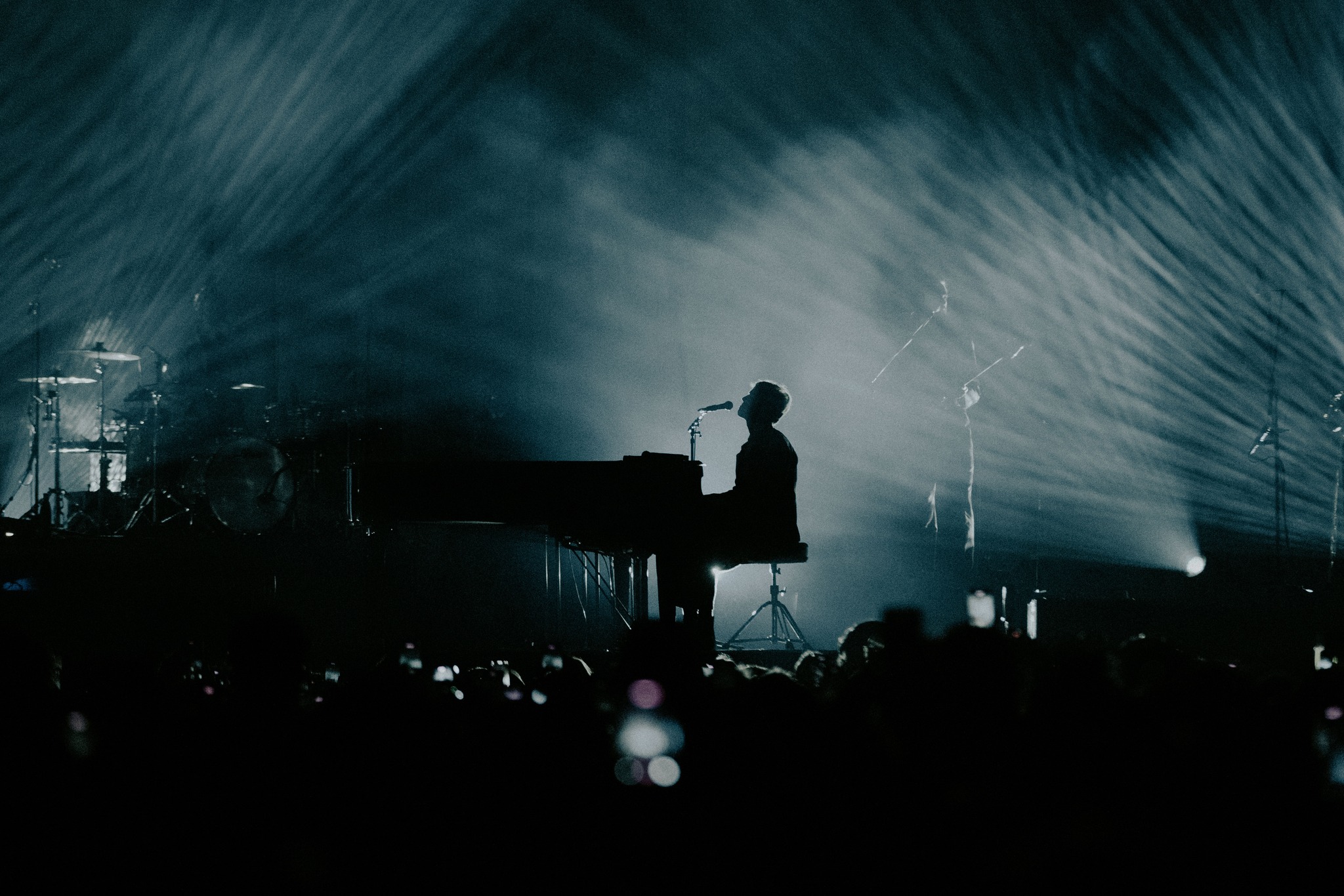
The concert began with a contemplative piano solo lit by a single fixture, no video, no IMAG, just the artist on a shadowy stage before 18,000 people performing “Strange House,” a song about change and the yearnings it brings. As the performance unfolds, the artist is ultimately joined by a seven-piece band and the stage itself is transformed by 150 fixtures projecting bold beams and colourful washes in every direction.
Such is the broad, dramatic sweep of BRIT Award winner Tom Odell’s recently concluded Wonderful Life arena tour of the UK and Europe. The tour’s stage production, with its profound changes is indicative of the remarkable path Odell’s own career has followed over the past decade, as he’s gone from playing small live music venues to sold-out arenas.
Tom’s longtime lighting designer, Joe Beardsmore of Phosphor-Tec has been with him every step of the way on this decade-long journey. This history endowed his lighting of the 27-city, 20-country Wonderful Life tour with a genuine passion that resonates through every scene in the show, which was lit by 125 CHAUVET Professional fixtures supplied by Coloursound Experiment.
“The first London show I did for Tom was at Islington Assembly Hall 10 years ago which was seen by 900 people, so to see 16,000 in the O2 Arena is testament to the hard work of Tom and all his crew,” said Joe. “It’s not been an overnight success it’s been hard work and a lot of shows.”
His extensive experience with his client has given Joe as sense of where the music is flowing at any given moment, which aided him in creating the tour design. “I do feel now that I know what him Tom and the band are headed, so there is no backing track, or click track at all on stage,” he explained. “Everything is live and has the ability to change, both in real time during a show and then also songs evolve though the year,
“For me, the show is all about emotion, and all I need to do is work on which songs I need to heighten different emotions on, and then try and use the show design with the lighting video and scenic to emphasize this,” continued Joe.
Color played a key role in helping Joe reflect the myriad emotions on stage. “We had two large drapes behind the stage that were critical to our design, and we did a lot of testing with colours on them,” he explained. “Tom came down to our studio and we built some colour palettes, which I could then track into the show. We made some interesting colours that I wouldn’t normally use — but they worked really well — some faded lavenders and lichen green colours, plus 5 different shades of blue tinted white.”
Although effective in helping him create the immersive looks he was after, the 26m by 8m drape did limit some of Joe lighting options, as he was unable to get any fixtures at a mid or side light positions. His rig’s 21 Color STRIKE M motorized strobe washes, which were positioned in a row at the base of his backdrop were critical in helping him meet this challenge.
“The Strike M fixtures for me were key to this show,” he declared. “The tilt function of the strobe — which I have to admit that at first, I really did think was fairly pointless on a strobe — was key. At times, the strobes were used as a super bright cyc washes on the drapes. Their ability to hold a saturated color like a dark red and then strobe the white tube over the top was really effective. Then for other songs, they could punch pixels through the band up to light the audience, which worked really effectively leaving fixtures in the air to light the backdrop.
“I used a lot of fans of colour from CTO to CTB and shades of saturated and desaturated colours,” continued Joe. “The pixels on the STRIKE Ms really helped me achieve a smooth colour fade, and with the wide angle of the fixture there were no shadows. It also colour matched well with the other fixtures in the air if I wanted to double the effect even though they were not matched fixtures.”
Also contributing to the wide range of looks on stage were 33 COLORado PXL Curves. “I designed a massive 33m long mid stage truss, which picked up the projection surfaces for the IMAG,” said Joe. “Plus, after the drapes were closed off the stage at the start of the show, I had this lovely massive straight line of 33 PXL Curves and 22 STRIKE Array blinders.
Joe, who ran his show on two ChamSys MagicQ 500M Stadium Consoles with a ChamSys MagicQ 250M tech desk, received great support from a lighting team that included crew chief Nick Barton, and network tech Geno Welburn, as well as techs Ed driver and Chris Brown, in addition to a production team that included rigger Josh Slade, camera director Bob Jaroc, Resolume programmer Giuli Sirianni, video crew chief Will Wright and drape operator Will Wiltshire.
“This was quite different from Tom’s early tours with a fairly locked in set list and more people on the shows,” mused Joe, who added it was not the same as the raw energy early shows, but points out that it was “beautifully sculptured and… covered an endless array of emotions” in its very varied looks.
Share this story





March 2026 issue

2026 A1 Buyers Guide