





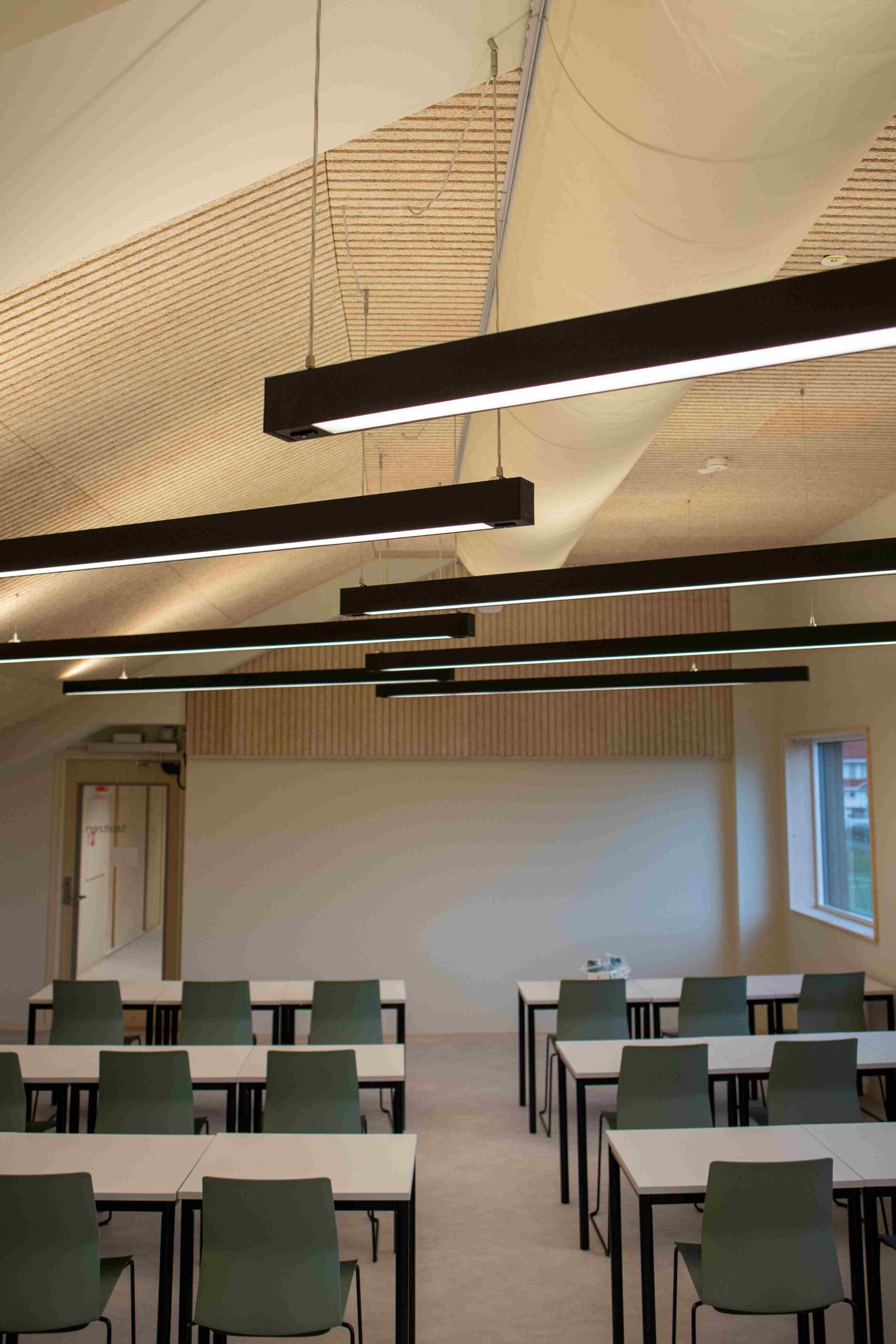
Glamox has supplied a smart lighting system to a secondary school for aspiring elite athletes in Norway, capable of wirelessly communicating with and triggering the heating, ventilation, and other building systems. This marks Glamox’s first-ever delivery of this kind in the Norwegian market – technology that also greatly reduces refurbishment costs for the client and energy costs for the owner.
Located in Bergen, Norway’s second largest city, Norges Toppidrettsgymnas Ungdomsskole (NTGU) is a private secondary school that combines academic education with regular sports training. It functions as a preparatory school for aspiring elite athletes, integrating general education and specialised sports-focused training into the school curriculum. The school is situated at Brann Stadium, the home of the local football team.
When the school building underwent a complete refurbishment, Glamox supplied more than 200 smart LED luminaires. These luminaires, which include a presence sensor to detect when people enter and leave a room, are wirelessly connected and controlled via a Glamox Wireless Radio Light Management System (LMS).
The LMS communicates with the building’s Building Management System (BMS) through an Application Programming Interface (API), enabling separate software applications to interact according to set rules and protocols.
“The end result is that when people enter the room, the lights are switched on, and the heating and ventilation systems are activated. On cold days, the heating is turned up to ensure comfort. Using lighting and heating only when and where they’re needed results in significant energy savings. And because the connectivity is wireless, the installation costs are reduced because it can be done quickly and efficiently without unnecessary and costly wiring,” says Vegard Einen, Project Manager, at SLS Elektro, which was the installer for the project and Glamox’s customer.
In general, upgrading an old lighting installation with an energy-efficient smart LED lighting system can reduce energy used for lighting by up to 90 per cent. Lower energy consumption saves money and lowers the customer’s carbon footprint.
Smart building systems like this one will become commonplace. As part of the EU’s goal to achieve net-zero greenhouse gas emissions by 2050, a directive (the EU Energy Performance of Buildings Directive) has set out a timeline and mandates that new and existing non-residential buildings adopt energy-saving technologies.
“Projects like these would have made Thomas Edison’s jaw drop, but the technology will become increasingly common in new buildings and major refurbishments. This is because heating, ventilation, air conditioning (HVAC) and lighting systems typically account for 60-80 per cent of energy use in public buildings. Smart lighting and building management systems, once the preserve of flagship luxury buildings, will become the new standard,” says Toril Bache Jenssen, Director of Sales for Glamox in Norway.
The project was managed by Novaform, with Sverre Nesbø as the project administrator, overseeing all phases from planning to completion. Electrical installations were handled by SLS Elektro, a Bergen-based firm, with Vegard Einem leading the work on-site. Architectural design was provided by Holon Arkitekter, with Heidi Bjerknes as the lead architect.
Share this story





March 2026 issue

2025 A1 Buyers Guide